TL;DR: collectibles auction software
- To start a trading card or memorabilia auction business, pick a niche, line up consignors, get items graded or authenticated, and sell through your own branded auction site rather than only on marketplaces.
- Each category needs different listing fields: grades and cert numbers for cards and coins, COAs for memorabilia, legal checks for curiosities.
- Our auction software runs on your own server, installed and set up by our team at no extra cost, for a one-time $899 to $2,999. No monthly fee and no cut of your sales.
- Category-specific extras like cert lookups or consignor statements are custom work at a one-time $1,000 to $10,000, and we can build and publish your own iOS and Android app.
See it working: try the live demo or tell us what you sell.
A 1952 Topps Mickey Mantle, a game-worn jersey, a first-edition holographic Charizard, a 1950s tin ray gun, a Civil War surgeon’s kit, a mounted deer head. They have almost nothing in common except one thing: their price is set by whoever wants them most on the night. That’s why collectibles end up at auction, and why so many collectors eventually start auction businesses of their own.
Collectibles auction software is the platform that runs those sales online: consignor intake, listings with grades and photos, real-time bidding, invoicing and payouts. This guide covers how to start the business, what the software needs for each category, and what it costs to run on your own site.
How to start a trading card or memorabilia auction business
Most successful card and memorabilia auction houses started as dealers or serious collectors who already knew the market. If that’s you, the path looks like this.
- Pick a lane. Vintage baseball, modern basketball rookie patch autographs (RPAs), Pokémon and other trading card games, sealed boxes, game-worn gear, autographs or coins. A clear niche attracts the right consignors and bidders faster than “everything collectible”.
- Line up inventory. Start with your own stock, then take consignments from collectors. Consignment is how auction houses grow without tying up cash in inventory.
- Grade and authenticate. Serious bidders pay for certainty. Cards usually go to PSA, Beckett (BGS), SGC or CGC; autographs and memorabilia to authenticators such as PSA/DNA, JSA or Beckett Authentication; coins to PCGS or NGC.
- Set your fees. Most auction businesses earn from a buyer’s premium plus a commission charged to the consignor. Publish both clearly; collectors compare.
- Choose where to sell. eBay and large marketplaces bring traffic but take fees and own the buyer relationship. Your own auction site keeps both. Many houses do both at first.
- Run a schedule. A weekly or monthly auction that always closes the same evening trains bidders to show up. Between auctions, a Buy It Now store keeps cash moving.
The general business side (licensing, insurance, first hires) is covered in how to start an auction house.
What the software needs for each type of collectible
The bidding engine is the same for every category. What changes is what goes into a listing and who’s allowed to bid.
| Category | Listing details buyers expect | Sale setup that works |
|---|---|---|
| Trading cards (sports, Pokémon, TCG) | Grading company, grade, cert number, front and back slab photos | Weekly timed auctions with soft close; Buy It Now for lower-value cards |
| Sealed boxes and packs | Set, year, seal condition, provenance photos | Timed auctions; bidder deposits for high-value boxes |
| Sports memorabilia and autographs | COA or LOA documents, photo matching, provenance | Document uploads on each lot; approved bidders for top lots |
| Coins and currency | Grading service, grade, cert number, obverse and reverse photos | Timed auctions plus Buy It Now for bullion and common coins |
| Vintage toys | Condition, box or no box, completeness, maker and year | Timed auctions; sealed bids for collections sold as one lot |
| Curiosities (natural history, medical, militaria) | Provenance, legal status, shipping restrictions | Private or invitation-only sales for sensitive items |
Everything in the right-hand column is built into our platform: timed and live auctions, proxy bidding, soft close, Buy It Now, sealed bids, private or invitation-only bidding, bidder deposits and approval, and document uploads on each lot.
A note on curiosities
Some of the most interesting lots carry legal strings. In the US, federal law restricts selling parts of most migratory birds, bans the sale of eagle parts, and limits trade in endangered species and many kinds of ivory, and some states go further. Check the U.S. Fish and Wildlife Service’s guidance (and your state’s rules) before you list taxidermy, ivory, feathers or anything made from them. Your terms and the platform’s approval tools let you keep restricted items to vetted, eligible buyers.
Worked example: a trading card consignment auction
Here’s how a typical setup looks. A card shop owner with a following of 2,000 collectors wants to run a Sunday-night auction of about 300 graded cards a week, mostly consigned, plus a Buy It Now store for singles.
Step 1: License and setup
They pick the Professional license at $1,999, one-time, which includes 10 hours of custom development. The platform runs on their own server under their own domain and brand, and our team installs and sets it up at no extra cost. Their only running cost is their hosting plan.
Step 2: Listings that answer the bidder’s first question
Every card listing shows the grading company, grade and cert number up front, with front and back photos of the slab. The 10 included development hours go on adding those as dedicated fields, so bidders can filter by grade.
Step 3: The weekly close
All 300 lots close on Sunday evening. Proxy bidding lets collectors set a maximum and go to bed, and soft close extends any lot that gets a late bid, so nobody wins by sniping. Our guide to bid increments covers the setting that quietly decides final prices.
Step 4: Trust on high-value lots
For cards above a set value, bidders must be approved or leave a deposit before they can bid. That stops the classic problem of a new account winning a $5,000 card and vanishing.
Step 5: Buy It Now between auctions
Lower-value singles and supplies sell as Buy It Now all week, so the site earns between Sundays and gives bidders a reason to visit. See auction vs. Buy It Now for which items suit which format.
Step 6: Consignors and growth
As consignments grow, they move to the Enterprise license ($2,999 one-time) for multi-vendor selling, so large consignors and other dealers can list directly, plus API access and 30 development hours.
What it costs
| Setup | License (one-time) | Typical custom work (one-time) |
|---|---|---|
| Collector or small shop selling its own stock | $899 | None |
| Card or memorabilia consignment auction (the example above) | $1,999 | $0 to $3,000 |
| Multi-dealer collectibles marketplace | $2,999 | $3,000 to $10,000 |
| Any of the above with your own iOS and Android app | Any | Quoted per project |
Installation and setup on your server are included in every license. There’s no monthly software fee and no commission on what you sell. Compare that with what other auction software costs over three years.
Custom work: $1,000 to $10,000, one time
Collectibles businesses tend to want a few things nobody else needs. Our team builds them into the platform at a fixed price, quoted up front and paid once. Common requests from card, coin and memorabilia sellers:
- Grade, grading company and cert number fields with search filters.
- Cert verification links or lookups for grading services.
- Consignor portals and settlement statements.
- Tiered buyer’s premium by price band.
- Shipping calculators with insurance for high-value items.
- Imports from a spreadsheet or inventory system for big consignments.
More on how we approach this on the custom auction software page.
Your own iOS and Android app
Bidders can use the site on any phone browser from day one. If you want your own app in the stores, with your logo on their home screen and push notifications for outbids and auction closes, we build native iOS and Android apps as custom work and publish them to the App Store and Google Play for you. See the mobile auction app page.
Marketplaces or your own site?
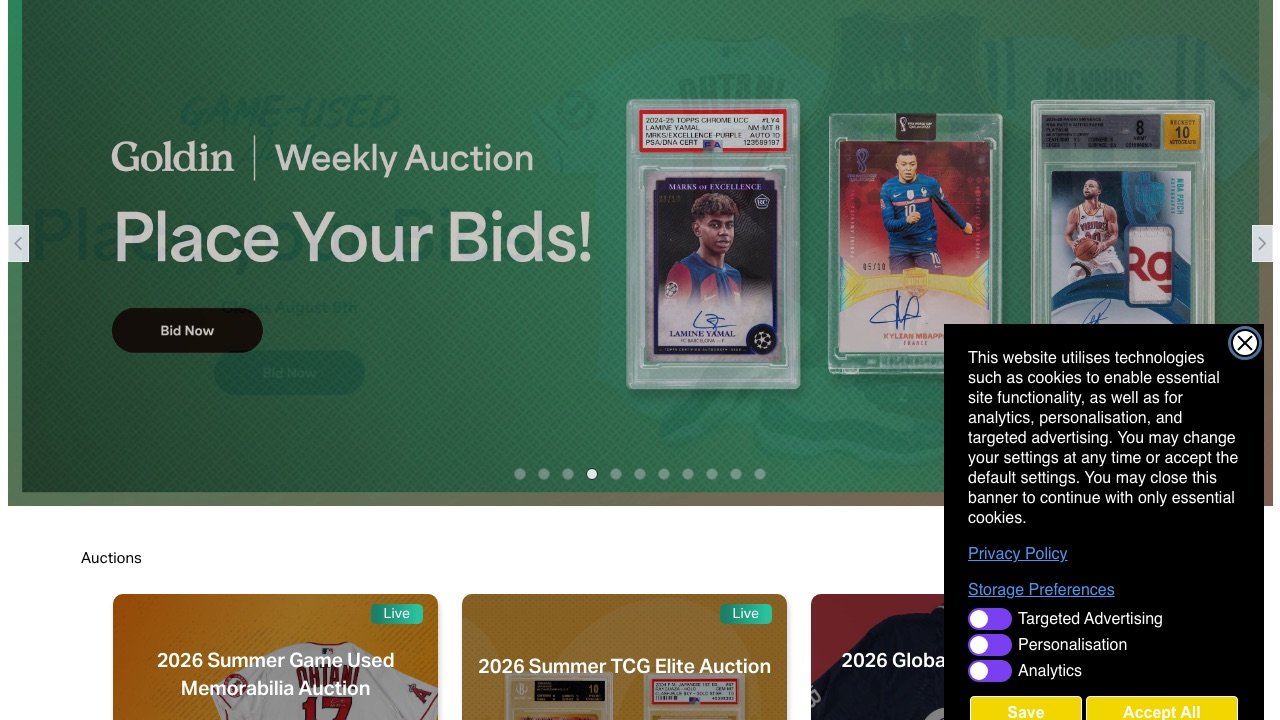
eBay, Goldin, Heritage and other big platforms bring buyers you don’t have yet, and live-selling apps like Whatnot are where card breaks happen. The trade-off is fees on every sale, their branding, and bidders who belong to the marketplace, not you. Our lists of collectibles auction sites and coin auction sites compare them.
The usual path is to use marketplaces for reach while building a bidder list on your own site, then move more of your weekly sales there as the list grows. If live streaming is central to your model, read how to build a site like Whatnot too.
Launch your collectibles auction site
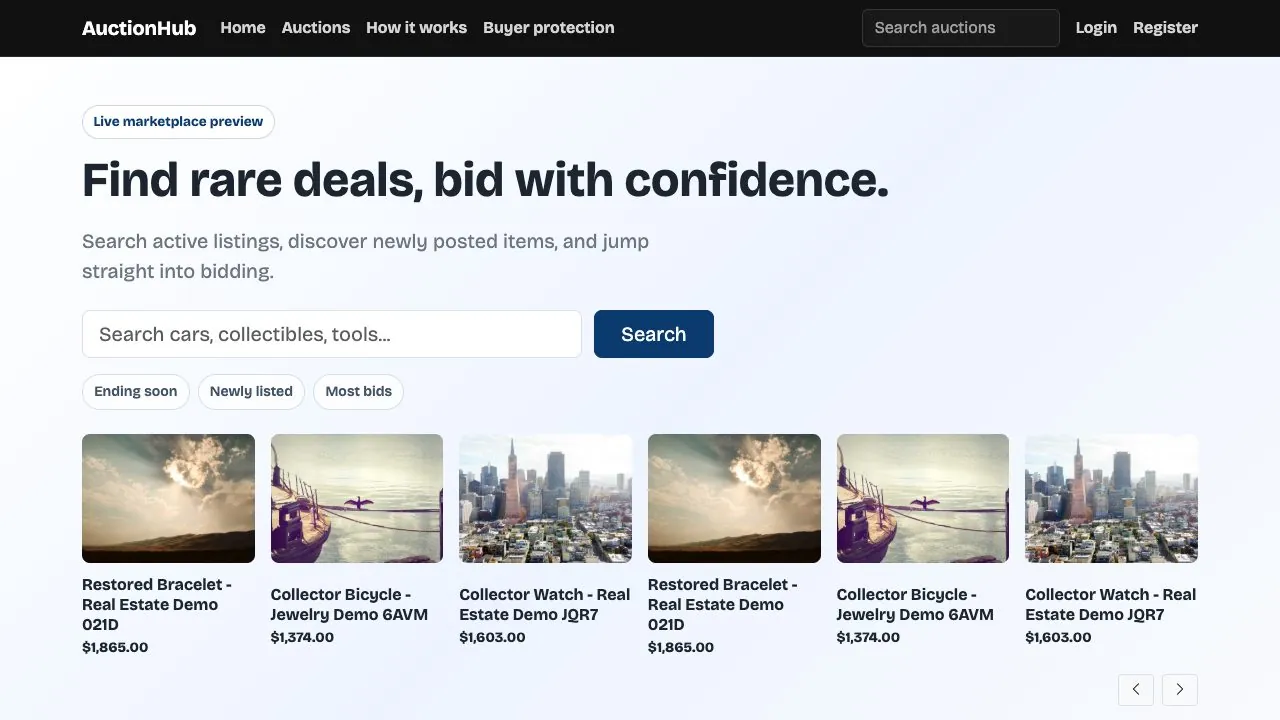
Try the live demo, see license pricing, or send us your requirements for a fixed quote on custom features and apps.
Frequently asked questions
How do I start a trading card auction business?
Pick a niche, build inventory from your own stock and consignments, get cards graded, set a buyer’s premium and consignor commission, and run a regular weekly or monthly auction on your own site, using marketplaces for extra reach at first.
What software do card and memorabilia auction houses use?
Many sell through marketplaces and live apps, but established houses usually run their own branded auction site with proxy bidding, soft close, bidder approval and fields for grades and certificates.
How much does collectibles auction software cost?
Our licenses are $899 to $2,999 one time, with installation and setup on your server included. Category-specific custom work runs $1,000 to $10,000, also one time.
Can I sell taxidermy or ivory at auction?
Sometimes, but many items are restricted. US federal law limits sales of most migratory bird parts, bans eagle parts and restricts many endangered species and ivory, and states can be stricter. Check before you list.
Can I get my own app for my auctions?
Yes. We build branded iOS and Android apps as custom work and publish them to the App Store and Google Play for you.
