TL;DR: tax deed and sheriff sales
- A tax deed sale auctions the property itself after the owner fails to pay property taxes. A tax lien sale auctions the right to collect the debt, with interest.
- A sheriff sale is a court-ordered auction, usually after a judicial foreclosure.
- Rules, deposits and redemption periods vary by state and county, so read the terms before bidding.
- Most counties now run these sales online, with registration, deposits and bidding on a web platform.
County, trustee or auction vendor? Our real estate auction software handles bidder registration, deposits, KYC and document vaults on a one-time license.
Every year, counties across the US sell thousands of properties at auction because the owners didn’t pay their property taxes or their mortgage. These sales go by different names depending on the state and the reason: tax deed sales, tax lien sales, sheriff sales, foreclosure auctions. They attract investors because prices can start well below market value, and they catch out beginners because the rules are strict and vary from one county to the next.
Here’s how each type works, what to check before bidding, and how these auctions run online.
Tax deed, tax lien and sheriff sales compared
| Tax deed sale | Tax lien sale | Sheriff sale | |
|---|---|---|---|
| Why it happens | Unpaid property taxes | Unpaid property taxes | Court judgment, usually a mortgage foreclosure |
| What you buy | The property (a tax deed) | A lien certificate: the right to collect the debt plus interest | The property, via a sheriff’s deed |
| Who runs it | County tax collector or treasurer | County tax collector or treasurer | County sheriff, on court order |
| Owner can still redeem? | In some states, for a period after the sale | Yes, during the redemption period | In some states, for a period after the sale |
| Main risk | Title issues, condition, redemption | Tying up money; foreclosing if unpaid | Surviving liens, occupants, no inspection |
How tax deed sales work
When property taxes go unpaid long enough, the county can sell the property itself to recover them. In a tax deed sale, bidding usually starts at the amount owed (taxes, interest, penalties and costs) and the highest bidder receives a tax deed. States such as California, Texas, Georgia and Pennsylvania sell tax deeds, though the details differ by state.
Florida is a hybrid. The county first sells tax lien certificates, and if a certificate stays unpaid for two years, the holder can apply for a tax deed sale of the property itself.
Any money above what’s owed, the surplus, generally belongs to the former owner or other lienholders, not the county. Winning bidders usually pay a deposit on the day and the balance within a short deadline set by the county.
How tax lien sales work
In a tax lien state, the county doesn’t sell the property. It sells a certificate that lets the buyer collect the unpaid taxes plus interest from the owner. If the owner pays, the investor gets their money back with interest. If the owner doesn’t pay within the redemption period, the certificate holder can usually start proceedings to take the property.
Some states auction liens by bidding down the interest rate: investors compete to accept the lowest return, which is effectively a reverse auction. Others use premium bidding, where investors bid up the amount paid above the lien.
How sheriff sales work
A sheriff sale is a public auction ordered by a court, most often after a judicial foreclosure, carried out by the county sheriff’s office. The lender typically places an opening bid, often up to the amount owed, and outside bidders have to beat it. If nobody does, the property goes back to the lender and later appears as bank-owned (REO) inventory.
Sheriff sales are the riskiest of the three for new buyers. You usually can’t inspect inside, the property is sold as-is, some liens can survive the sale, and you may have to remove occupants. Payment terms are tight: a deposit at the sale and the balance within days.
Redemption periods
A redemption period is the window in which the former owner can reclaim the property by paying what’s owed plus interest or penalties. Some states have none after the sale, others allow months or more. During that window, the buyer generally can’t take possession, rent or renovate. Always check the redemption rules for the specific state and sale type before bidding.
What to check before you bid
- The county’s sale terms: deposit, payment deadline and accepted payment methods.
- Whether you’re buying a deed or a lien, and the redemption period.
- A title search for liens that may survive the sale, such as some government liens.
- The property itself: drive by, check flood zones, access and occupancy.
- What happens if the sale is later cancelled or set aside.
For other ways to buy distressed property at auction, see our guides to real estate auction sites, Auction.com alternatives and land auctions.
How these auctions run online
Most counties have moved their tax and foreclosure sales online, either on their own website or through a vendor. Bid4Assets, a Liquidity Services brand, is one of the best-known platforms for county tax sales, and many Florida counties run foreclosure and tax deed sales on online platforms rather than at the courthouse steps.
Running a county property auction online takes more than a bidding page. The platform needs to handle:
- Bidder registration with identity checks, tax forms and acceptance of the sale terms.
- Deposits collected before bidding, with limits on how much each bidder can win.
- Property files for each parcel: legal description, assessed value, maps and notices.
- Bidding formats set by state law: open ascending, sealed bids, or interest-rate bid-down for liens.
- Strict closing times and a full, timestamped record of every bid for audits and disputes.
- Post-sale invoicing, payment deadlines and deed or certificate issuance.
Our real estate auction software covers the core of that list: bidder registration with KYC, proof of funds and deposits, due diligence vaults for parcel documents, multi-parcel bidding, sealed bids and timed online auctions with soft close. It runs on your own server under your agency’s or company’s brand, installed and set up by our team at no extra cost, for a one-time $899 to $2,999. State-specific rules, such as interest-rate bid-down auctions or certificate issuance, are built as custom work, typically $1,000 to $10,000 one time. Our guide to building a site like GovDeals covers the wider government auction setup.
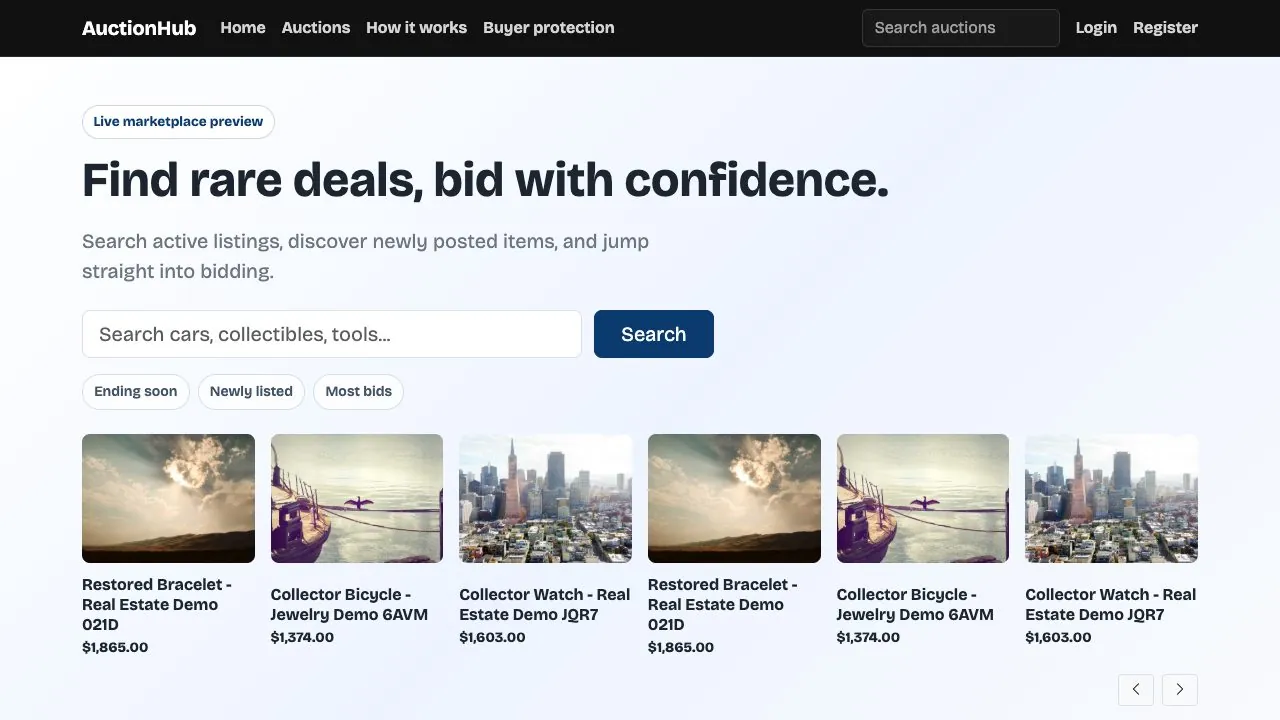
Run property auctions online
See the real estate auction features, try the live demo, or tell us about your sale rules.
Frequently asked questions
What is a tax deed sale?
A county auction of a property whose owner didn’t pay property taxes. The winning bidder receives a tax deed to the property, subject to the state’s rules on redemption and title.
What is the difference between a tax deed and a tax lien?
A tax deed sale sells the property. A tax lien sale sells the right to collect the unpaid taxes plus interest, with the property only transferring if the owner never pays.
What is a sheriff sale?
A court-ordered public auction, usually after a judicial foreclosure, carried out by the county sheriff. The property is sold as-is, often without an interior inspection.
Can you get a house for the taxes owed?
Occasionally the opening bid is close to the taxes owed, but competitive bidding usually pushes prices well above it, and title, condition and redemption risks still apply.
Are tax deed and sheriff sales held online?
Increasingly, yes. Many counties now register bidders, take deposits and run bidding online, either on their own site or through a vendor platform.
