You can build an auction website for free. That is a true statement, and almost every article on the subject stops there. What nobody tells you is where the free version breaks, and it always breaks in the same place: the last ninety seconds of your first busy auction.
This guide covers the routes that genuinely work at zero cost, what each one can handle, and the point at which free stops being cheap.

Route 1: WordPress plus a free auction plugin
Cost: hosting only, from around $5 a month.
Realistic capacity: small catalogues, low simultaneous bidding.
The most common free route. Install WordPress, add WooCommerce, add one of the free auction extensions. You get timed listings, basic proxy bidding and email notifications.
Where it works: a school fundraiser, a club sale, a one-off charity event with fifty lots and thirty bidders. Where it fails: concurrency. Most free plugins write bids through the standard WordPress post-meta path with no locking. When twenty people bid on the same lot within the same second, you get lost bids, incorrect high bidders and — worst case — two winners for one lot.
The second failure point is soft close. Without reliable anti-sniping extension, your hammer prices will be measurably lower than they should be, because bidders learn to wait until the final second.
Route 2: Open-source marketplace software
Cost: free licence, but hosting plus your own time.
Realistic capacity: medium, if you have development skills.
There are solid open-source ecommerce and marketplace codebases you can extend with auction logic. This gives you genuine control and no licensing cost.
The honest catch: you are now the maintainer. Security patches, payment gateway updates, PHP or framework version bumps — all yours. If you are a developer building for yourself, this is a reasonable trade. If you are a business owner planning to hire someone, you are paying for the build anyway and “free” only describes the licence.
Route 3: Free tiers of hosted platforms
Cost: free until you transact.
Realistic capacity: proof of concept.
Several hosted marketplace and fundraising platforms offer free plans that charge only on transactions or ask bidders to cover the fee. For nonprofits in particular this is genuinely viable — a free silent auction platform funded by an optional bidder contribution can run a real event at no cost to you.
The trade is control and branding. You are on someone else’s domain, with their fee structure, and you do not own the bidder data. For a one-off event that is fine. For a business, that bidder list is the asset you are giving away.
Route 4: Sell through an existing marketplace
Cost: commission per sale, no upfront.
Not building a website at all — running your auctions on eBay, HiBid or a category specialist. This is the genuinely rational choice for anyone whose volume does not yet justify a platform. You pay only when you sell. Our rundown of the best online auction sites covers where each category performs.
The costs that are not money
Free routes have real prices that do not appear on an invoice:
- Failed closes. One auction that breaks at the finish costs you the bidders who were watching. They do not come back for the second attempt.
- Your time. Forty hours configuring a free stack is not free unless your time is worthless.
- Manual settlement. Without automated invoicing you are writing emails and chasing payments by hand. At scale this is a part-time job.
- Lost hammer price. No soft close, no outbid notifications, no mobile experience. Each of these costs a few percent, and they compound.
A sensible sequence
The approach that works for most people: start free to validate that anyone wants to bid on what you are selling. Run three or four sales on a marketplace or a free plugin. Measure the volume.
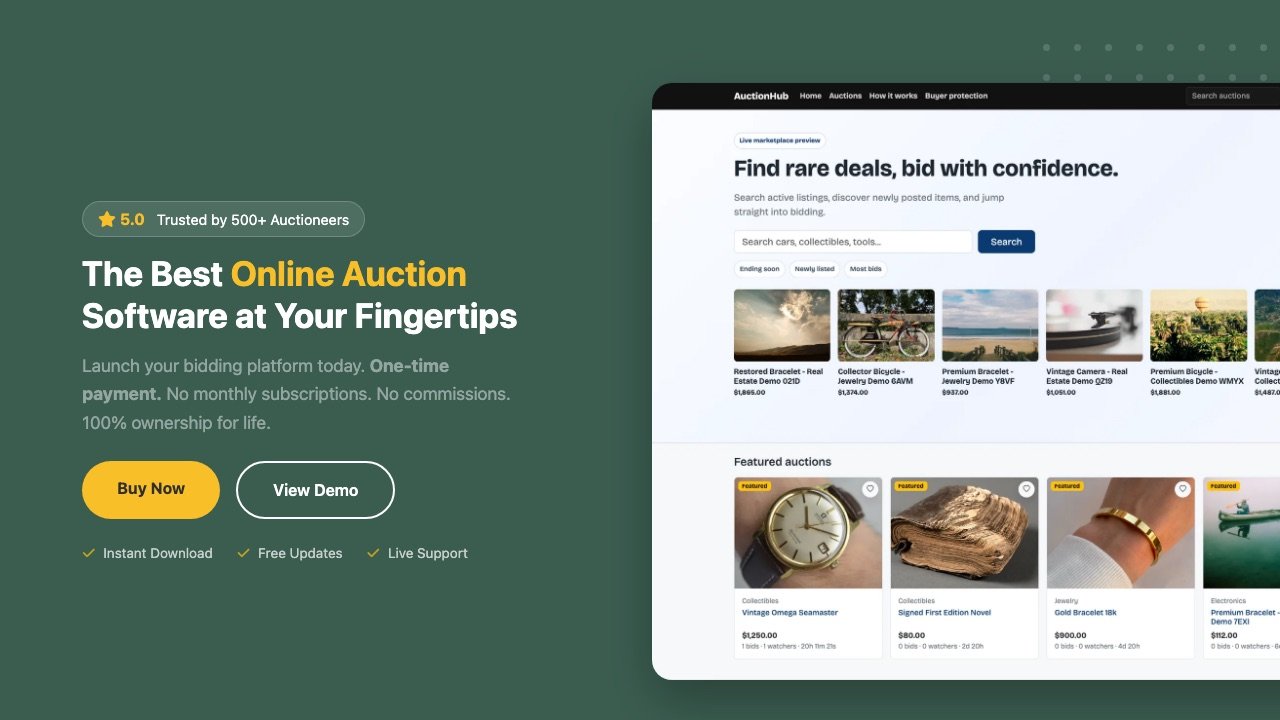
If it works, move to licensed software before you outgrow the free version rather than after — the migration is much easier with 200 users than 5,000. Our cost breakdown for building an auction website covers what that step actually costs, and buy online auction software shows the entry point.
Frequently asked questions
Is there a genuinely free auction script?
Several exist. Most are unmaintained, and an unmaintained payment-handling codebase is a security liability rather than a bargain. Check the last commit date before you install anything.
Can a free plugin handle a live auction?
Not reliably. Live and simulcast bidding needs persistent connections and server-authoritative timing, which is beyond what a standard plugin architecture provides.
What is the cheapest option that actually works at scale?
A licensed platform with a one-time fee, self-hosted. See SaaS vs. self-hosted auction software, or talk to our team.
