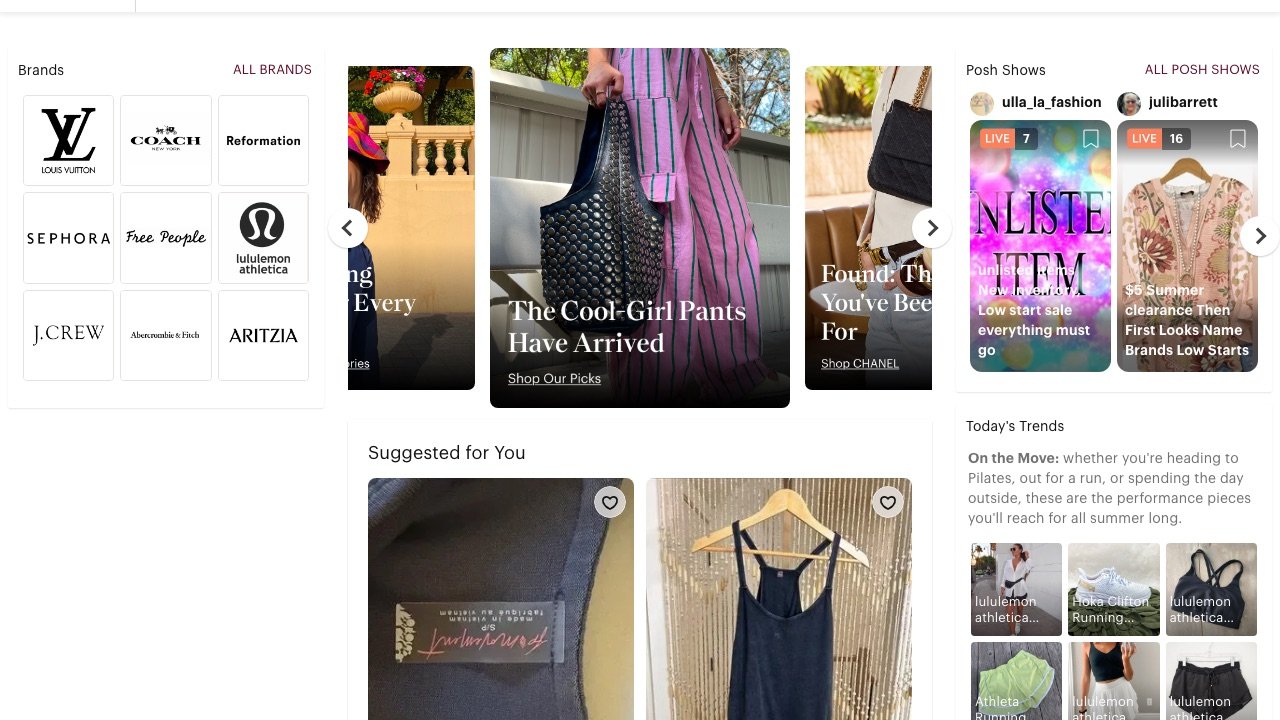
Poshmark’s genuine innovation was making selling social. Sellers share each other’s listings, attend virtual “Posh Parties”, and follow each other — which means discovery happens through the community rather than through search. That loop is why the platform grew without buying traffic.
Copy the listings page and you have built nothing. Copy the loop and you have something. Here is what that actually involves.
1. The sharing mechanic
The core behaviour: a seller shares another seller’s listing to their own followers. Everyone does this constantly, because sharing others’ items is how you get your own items shared back.
What that requires technically:
- A follow graph, with feeds assembled from followed sellers and shared items
- Share actions that are cheap — one tap, no confirmation dialog
- Feed ranking that mixes recency, relevance and share activity
- Reciprocity signals so sellers can see who shares their items, because that reciprocity is what sustains the behaviour
- Notification design that surfaces shares without becoming noise
The economic insight underneath: your sellers are doing your distribution for free, in exchange for status and reciprocal exposure. Design the incentive loop carefully or the behaviour never establishes.
2. Offers and negotiation, not fixed prices
Resale buyers expect to haggle. Poshmark handles this with private offers, offers to likers, and bundle discounts when a buyer takes several items from one closet.
The bundle mechanic is worth copying specifically. It raises average order value, and it reduces per-item shipping cost — which in low-value fashion resale is often the difference between a viable transaction and a pointless one.
3. Prepaid shipping is not optional
The single biggest friction in peer-to-peer resale is that ordinary people do not know how to ship things. Poshmark solved it with a flat-rate prepaid label generated at sale, paid by the buyer, printed by the seller.
Flat rate is the important part. Variable shipping calculated by weight and distance is technically more accurate and commercially worse, because it introduces uncertainty at checkout. A single predictable number converts better than an accurate one.
You will need carrier integration for label generation, tracking ingestion to drive payment release, and a policy for items that exceed the flat-rate weight band.
4. Payment holds and the dispute window
Funds are held until the buyer accepts the item or an acceptance window expires. This is what makes strangers willing to transact.
What you need: escrow-style holds, a defined auto-accept period, a dispute process with photo evidence, a return path with prepaid labels, and seller payout scheduling. Getting the balance right is genuinely difficult — too buyer-friendly and sellers leave; too seller-friendly and buyer trust collapses.
5. Authentication above a threshold
Luxury resale attracts counterfeits, and platforms that ignore this end up with a reputation problem that is very hard to reverse. The standard approach is routing items above a value threshold through an authentication centre, with the item shipping seller → platform → buyer.
That adds cost and transit time, so the threshold is a genuine commercial decision. Set it too low and your economics break; too high and fakes circulate freely in the tier just below it.
6. The supply-side problem comes first
This is the part most people building a marketplace get backwards. Resale marketplaces fail on supply, not demand. A buyer arriving to find 200 listings leaves and does not return.
Practical implications for the build:
- Listing must be trivially fast on mobile. Photograph, autofill category, price, done — under sixty seconds. Every additional field costs you listings.
- Bulk tools for power sellers, who will provide a disproportionate share of your inventory.
- Cross-listing import from platforms sellers already use. Yes, this means helping them keep a foot elsewhere. Do it anyway — the alternative is they never start.
- Seller education on photography and pricing, which measurably improves both listing quality and sell-through.
7. The fee model is strategic
Three approaches, each with real consequences:
- Seller commission (Poshmark’s model) — simple, and it discourages listing cheap items
- Buyer-paid fees (Vinted’s model) — sellers list freely, which solves supply, and buyers absorb the cost
- Optional promotion — free to list, pay for visibility
Vinted’s approach is worth serious thought if supply is your constraint, which it usually is. Removing all seller cost removes the biggest barrier to listing.
8. Build versus license
Listings, payments, escrow, messaging and shipping integration are commodity infrastructure — license them. Your engineering effort belongs in the social graph, the feed and the sharing loop, because that is the actual product.
See multi-vendor marketplace platform for the base layer and marketplace build costs for budgeting. If you want auctions alongside fixed-price listings — which works well for one-of-a-kind vintage — see auction website builder.
Frequently asked questions
Do I need the social features to compete?
You need some discovery mechanism that is not paid acquisition. Social sharing is one answer; strong curation or a tight niche community are others. A pure listings site with no discovery engine will not grow.
Should I include auctions?
For unique vintage and collectible fashion, yes — bidding discovers price better than a seller guessing. For current-season basics, fixed price is correct.
What is the hardest part?
Reaching critical mass on supply before buyers arrive. It is a commercial problem more than a technical one. Talk to our team about sequencing a launch.
