Cars & Bids launched in 2020 and became one of the two big names in online enthusiast car auctions in a few years. The format is simple to describe: a curated list of 1980s-and-newer enthusiast cars, seven-day timed auctions, detailed listings with a known-flaws section, an open comment thread, and a buyer’s fee that pays for the whole operation. Building the software side of that is a solved problem. Building the audience is the hard part, and it’s where most clones fail.
This guide covers both: what a site like Cars & Bids actually needs, what it costs to build with our software, and how to pick a niche where you can win.
TL;DR: building a site like Cars & Bids
- Core features: seven-day timed auctions with soft close, proxy bidding, rich listings, comments and seller Q&A, card verification and a buyer’s fee
- Our car auction software covers the auction engine out of the box, from a one-time $899 to $2,999 license
- Comments, seller Q&A and an editorial “our take” block are custom work, $1,000 to $10,000 one time, partly covered by the development hours in the higher tiers
- It runs on your own server, installed and set up by our team at no extra cost. iOS and Android apps are available as custom work.
- Don’t copy Cars & Bids head-on. Pick a niche it serves badly.
Want to see the auction engine first? Open the live demo or tell us about your project.
How Cars & Bids works
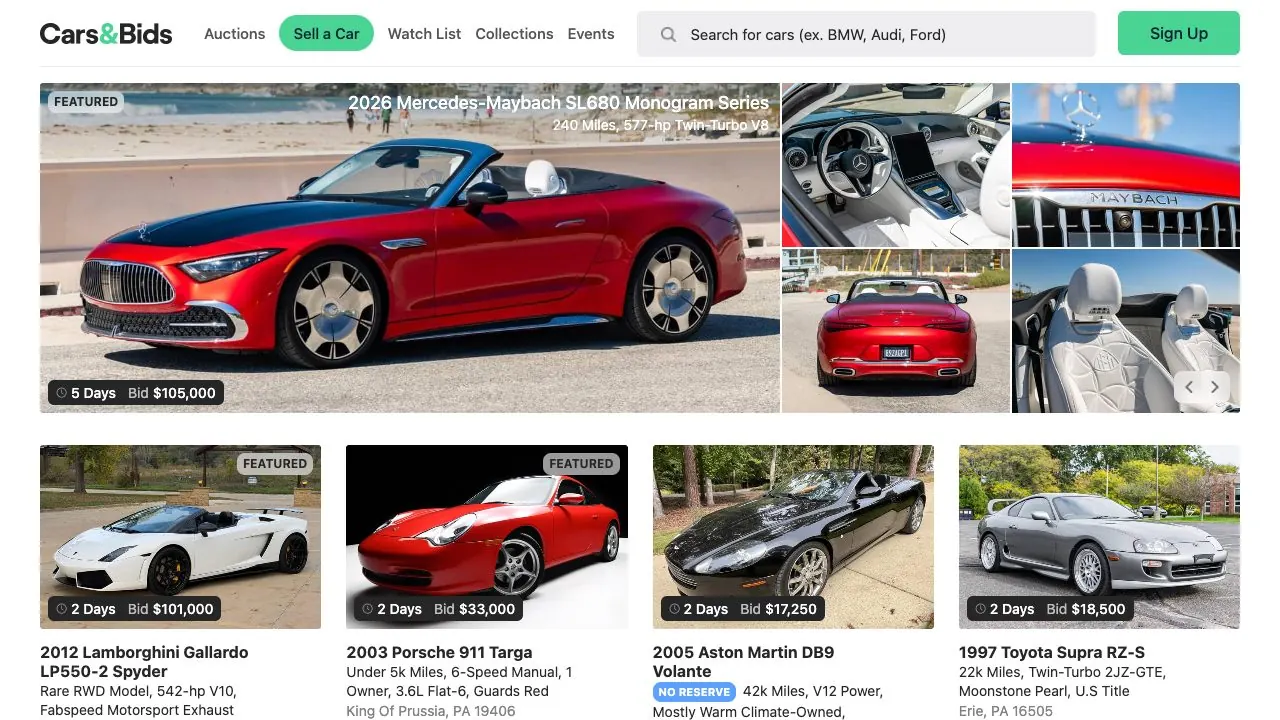
A seller submits a car. The Cars & Bids team decides whether to accept it, sometimes asking for a lower reserve, and writes the listing with the seller. Each listing follows the same template: a large photo gallery, highlights, equipment, modifications, known flaws, recent service, ownership history, seller notes, often a video, and a short editorial take from founder Doug DeMuro.
The auction runs for seven days. Anyone can read the comments, and registered users can comment or ask the seller questions publicly. To bid, you register a credit card, and the site places a hold for the buyer’s fee. Bids placed in the final moments extend the clock, so sniping doesn’t work.
When the auction ends, the winner pays the buyer’s fee to Cars & Bids and usually pays the seller directly for the car, with an optional secure checkout offered by the site. At the time of writing, the fee is 5% of the winning bid, with a $250 minimum and a $7,500 maximum, and sellers list for free. (We compare it with Bring a Trailer’s fees in Cars & Bids vs. Bring a Trailer.)
Notice what Cars & Bids doesn’t do. It doesn’t own or store the cars, and it doesn’t take a cut from the seller. It’s a media and marketplace business that charges for matching the buyer and the car. That keeps the operation light, and it’s why the model is attractive to copy.
Features a site like Cars & Bids needs
Here’s every piece of the format, and how our software handles it. “Included” means it works out of the box. “Custom” means we build it for you as one-time development work.
| Cars & Bids feature | What it does | Premium Auction Software |
|---|---|---|
| Timed auctions (seven days) | Fixed end time, set per listing | Included |
| Anti-sniping extension | Late bids push the end time back | Included (soft close) |
| Reserve and no-reserve listings | Seller chooses a minimum, or none | Included |
| Proxy bidding | Bidders set a maximum, the system bids for them | Included |
| Large photo galleries and video | Hundreds of photos per car, embedded walkaround video | Included |
| VIN details | Year, make, model and trim filled in from the VIN | Included (VIN decoding) |
| Service records and documents | PDFs and scans attached to the listing | Included (document uploads) |
| Bidder verification | Card on file and a hold before bidding | Included (deposits and bidder approval) |
| Buyer’s fee | Percentage with a minimum and a cap | Included (buyer’s premium through Stripe or PayPal) |
| Payment protection for big sales | Safe payment between buyer and seller | Included (Escrow.com) |
| Structured listing template | Highlights, equipment, mods, known flaws, service, ownership | Custom (or use the description editor with a fixed layout) |
| Public comments and seller Q&A | Community discussion on each listing | Custom |
| Editorial “our take” block | A short staff opinion on every car | Custom |
| Seller submission form | Sellers send their car for review | Custom form, or multi-vendor accounts on Enterprise |
| Results archive | Past sale prices, searchable | Custom |
| Mobile apps | iOS and Android bidding | Custom, published to the stores for you |
The auction engine is the part that’s expensive to get wrong, and it’s the part that comes ready. The community layer is what makes a site feel like Cars & Bids, and it’s the part we’d build specifically for you.
Curated or open? Decide before you build
Cars & Bids is curated. Sellers can’t post a listing themselves. They submit, staff approve, and staff publish. That’s slower, but it’s why the listings look consistent and why buyers trust them.
For a new site, we’d start curated too. You can run it on any license tier: sellers send you their car details, your team builds the listing in the admin panel, and the seller approves it before it goes live. Twenty well-presented cars beat two hundred sloppy ones when you’re trying to earn a reputation.
An open marketplace, where dealers and private sellers manage their own listings, needs the multi-vendor features in the Enterprise license. It scales better later. It’s also how you end up with blurry phone photos and “runs great, needs nothing” descriptions, which is exactly what Cars & Bids built its brand against.
What it costs
Our software is a one-time license, not a subscription, and it runs on your own server. Our team installs and sets it up at no extra cost.
| Item | Cost | Notes |
|---|---|---|
| Software license | $899, $1,999 or $2,999 one time | Professional includes 10 development hours, Enterprise includes 30 plus multi-vendor and API |
| Installation and setup | Included | On your own server |
| Comments, Q&A, listing template, editorial block | $1,000 to $10,000 one time | Depends on scope; included hours reduce it |
| iOS and Android apps | Custom quote | We build and publish them for you |
| Hosting | Your server, your choice | Paid to your host, not to us |
| Payment processing | Stripe or PayPal rates | On the buyer’s fee you collect |
As a rough guide, a Cars & Bids-style launch on the Enterprise license with a mid-sized custom package comes to about $6,000 to $10,000 in total, one time. Building the same auction engine from scratch with an agency usually costs far more, and the bugs are yours to fix. Our online auction software pricing guide compares the options.
Revenue math
Using a Cars & Bids-style fee (5%, $250 minimum, $7,500 maximum):
| Cars sold per month | Average sale | Fee per car | Monthly fee revenue |
|---|---|---|---|
| 5 | $20,000 | $1,000 | $5,000 |
| 15 | $30,000 | $1,500 | $22,500 |
| 40 | $35,000 | $1,750 | $70,000 |
At five cars a month, the software pays for itself inside two months. Sell-through matters as much as volume, though. A car that doesn’t meet reserve earns you nothing, which is why Cars & Bids pushes sellers toward realistic reserves or no reserve at all. Other ways to earn (seller fees, featured listings, photography packages) are in how online auction sites make money.
Pick a niche Cars & Bids serves badly
This is where we’d push back on the word “clone.” Cars & Bids has Doug DeMuro’s YouTube audience behind it. A general modern enthusiast site launched today will lose to it on almost every car. A focused site can win.
Some niches that are open, or only loosely served:
- A single marque or platform. Land Cruisers, air-cooled VWs, BMW M cars, Miatas. Owners’ clubs already exist, and the auction becomes their marketplace.
- Trucks, 4x4s and overland builds, where modifications are the selling point.
- Your country or region. Cars & Bids focuses on the US. Local sites in Australia, the UK, Europe or the Gulf avoid shipping and import problems.
- Budget enthusiast cars under $10,000, where the $250 minimum fee feels heavy and a lower fee is a real selling point.
- Race cars and track cars, with logbooks and spares packages.
- Motorcycles, which Cars & Bids doesn’t run.
Launches that work start with supply. Line up 20 to 30 cars before you open to bidders, through your own dealership, a club, or sellers you know. An empty auction site doesn’t get a second look.
Launch plan, step by step
First, we install the software on your server and set up your domain, payments, fees and branding. Over the following weeks we build the custom pieces (listing template, comments, Q&A, editorial block) while you collect your first cars and shoot photos. Then a soft launch with a handful of no-reserve cars, which pull in bidders faster than anything else. Mobile apps can follow once the web version has traffic.
If you sell cars yourself, a dealer or wholesale setup may suit you better than an enthusiast marketplace. The car auction website guide walks through a dealer example, and building a Bring a Trailer clone covers the classic-car version of this format.
Launch your own Cars & Bids-style auction site
One-time license, installed on your server at no extra cost, with custom community features built for you. Try the live demo, see license pricing, or tell us about your niche.
Frequently asked questions
Can I legally build a site like Cars & Bids?
Yes, the format is open to anyone. Don’t copy the name, logo, design or listing text. Build your own brand around the same kind of auction.
How long does it take to launch?
Installation and setup take days. With the custom community features, plan on several weeks before your first public auction; the exact time depends on the scope you choose.
Do I need to handle the full payment for the car?
No. Like Cars & Bids, you can collect only the buyer’s fee and let the buyer pay the seller directly. For expensive cars, Escrow.com is built in.
Can bidders use a mobile app?
The site works in mobile browsers from day one. Native iOS and Android apps are custom work, and we publish them to the App Store and Google Play for you.
Is this the same as Bring a Trailer clone software?
Mostly. The auction engine is the same. Cars & Bids-style sites lean on modern cars, structured listings and an editorial voice, while Bring a Trailer-style sites cover older classics and more categories. Our Bring a Trailer alternatives list shows how other niche sites position themselves.
