TL;DR: online auction software pricing
- Vendors charge in five ways: monthly subscription, per workstation, subscription plus implementation, a cut of each sale or a one-time license.
- Published examples: AuctionMethod $100 to $1,500+ a month, Auction Flex $85 a month per workstation, Auction Experts €720 a month plus implementation.
- Over three years, a one-time license is usually the cheapest model once you run more than a sale or two a month. A commission is the most expensive once your sales grow.
- Always add activation fees, payment processing and per-lot or per-sale fees before you compare.
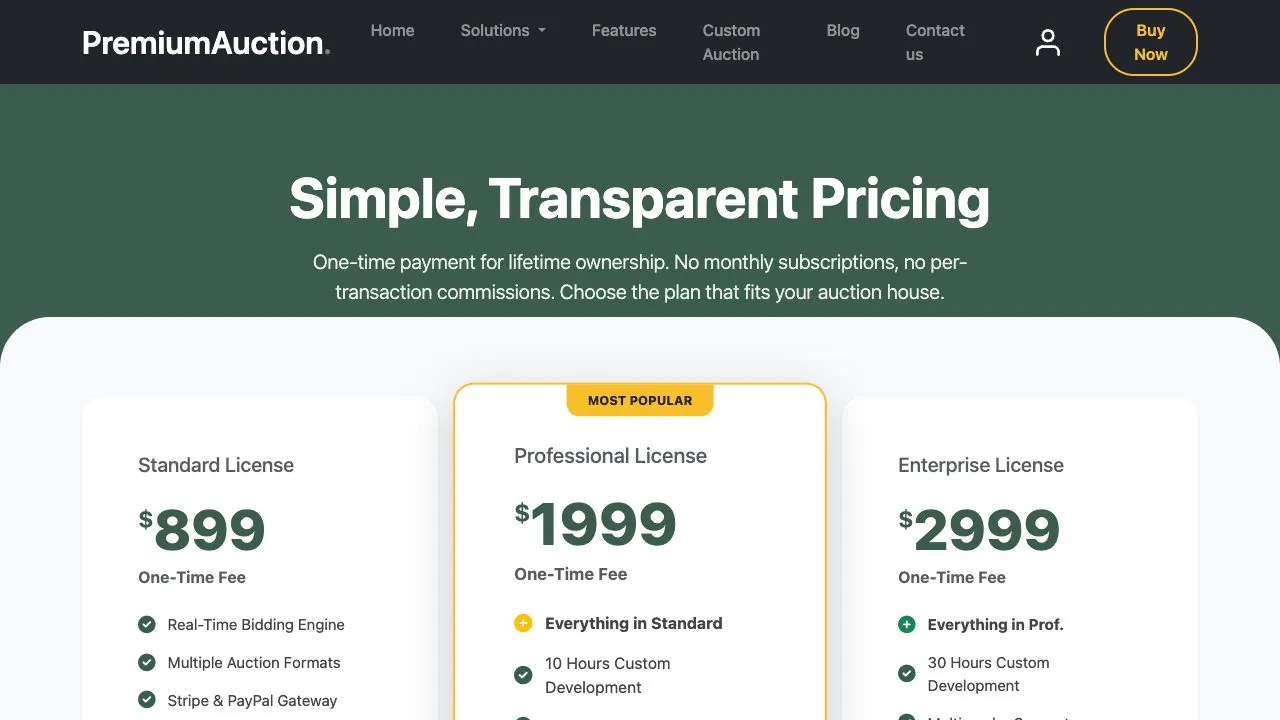
Our auction software is a one-time license: $899, $1,999 or $2,999, with no monthly fee and no commission.
Online auction software costs anything from $0 to over $1,500 a month, and the sticker price is the least useful number on a vendor’s page. What matters is how the price grows with you. A $100-a-month plan and a “free” platform that takes a share of every sale can cost the same in year one and wildly different amounts by year three.
Here’s how each pricing model works, with real prices vendors publish, followed by a three-year comparison.
1. Monthly subscription (hosted SaaS)
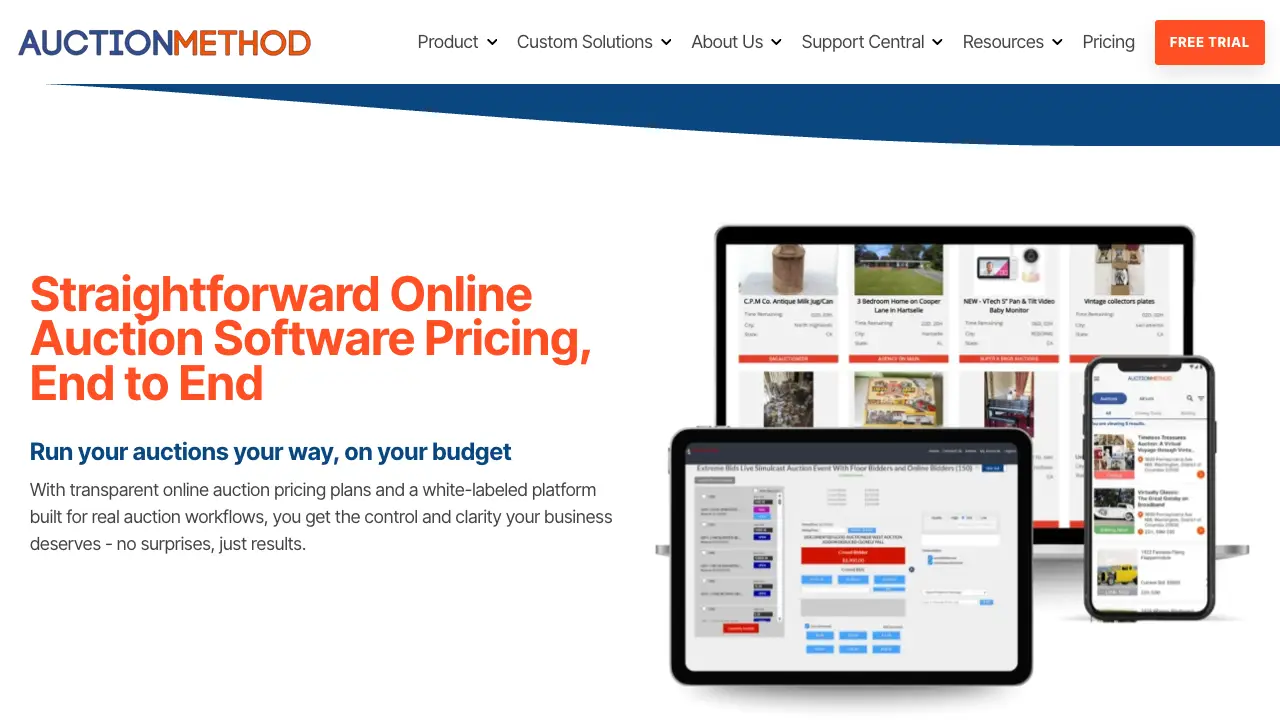
The most common model. You pay a monthly fee, the vendor hosts everything, and higher tiers add features. AuctionMethod publishes a clear example: $100 a month for its entry plan, $750 for the plan with automation and premium features, and $1,500 a month and up for custom workflows. Each tier also has a one-time account activation fee of $250, $2,500 or $5,000. Optional add-ons, such as its pickup scheduling module, are priced monthly on top.
Good for: starting fast with no server to manage. Watch for: activation fees, paid add-ons and how much it costs to remove the vendor’s branding.
2. Per workstation (desktop clerking software)
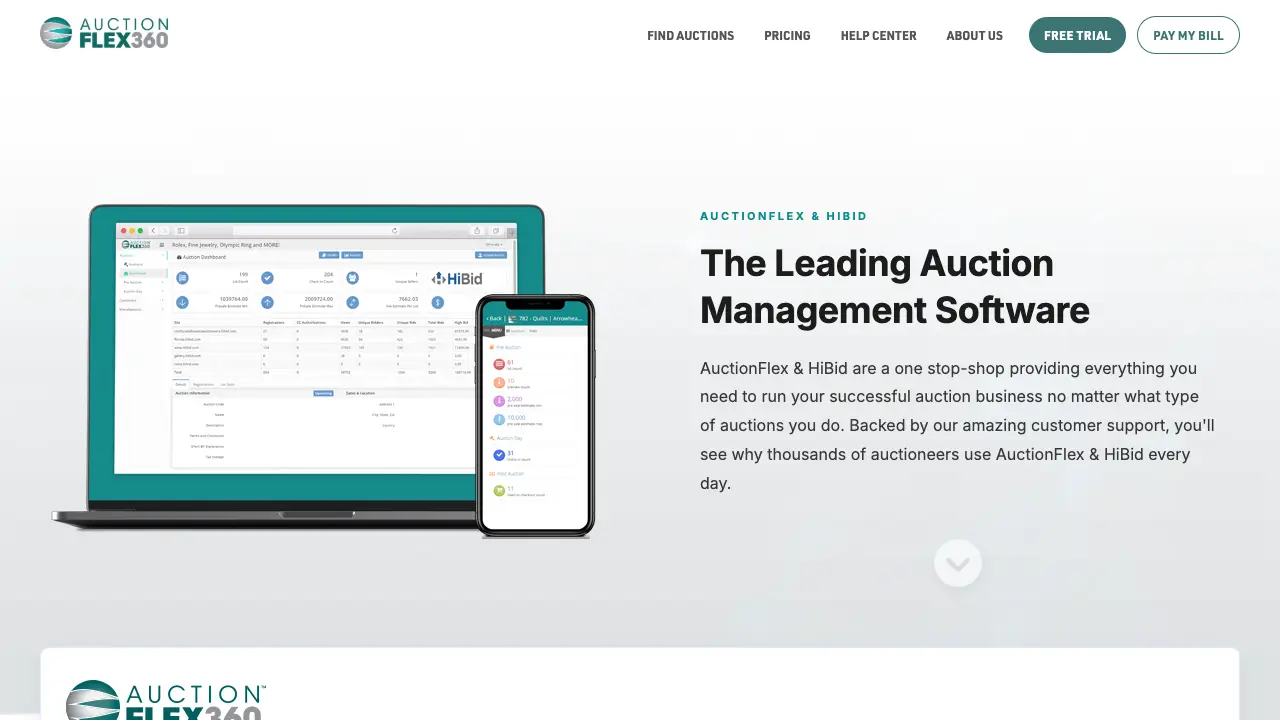
Older auction management tools are priced by the number of computers running them. Auction Flex lists one workstation at $85 a month, rising to $190 for four, with unlimited workstations at $550 a month. Online bidding is usually a separate cost. Auction Flex pairs with HiBid, and its pricing page lists separate fees for that.
Good for: live auction companies that clerk on-site. Watch for: the total once you add online bidding fees on top of the desktop software.
3. Subscription plus implementation fee
Platforms aimed at established auction houses often charge a setup project plus a monthly fee. Auction Experts, for example, lists its Professional plan at €720 a month with implementation from €2,450, excluding VAT. Enterprise branded-app vendors like Auction Mobility quote by package rather than publishing prices.
Good for: houses that want a polished, managed platform and have the budget. Watch for: contract length and what happens to your data if you leave.
4. A cut of each sale (marketplaces)
Bidding marketplaces and some “free” platforms make money from transactions instead of subscriptions: a percentage of the hammer price, a per-lot fee, or a buyer’s premium or internet surcharge added for bidders. Nonprofit platforms work similarly. Givebutter, for instance, markets its auction tool as free software for nonprofits. You get a large audience or a zero upfront cost, but the fee grows with every sale, and the bidder relationship belongs to the platform. Our guide to how online auction sites make money breaks down each fee type.
Good for: testing demand, or very occasional sales. Watch for: the effective rate once you include buyer-side fees, which can push bids down.
5. One-time license (self-hosted)
You pay once, install the software on your own server, and keep it. There’s no monthly fee and no commission, but you pay for your own hosting (often $20 to $100 a month). With our licenses, installation and setup are included. Our own licenses are $899, $1,999 (Professional, with 10 hours of custom development) and $2,999 (Enterprise, with 30 hours, multi-vendor selling and API access).
Good for: anyone running auctions every month, or who wants custom features. Watch for: hosting quality and whether updates are included.
Three-year cost comparison
Here’s what each model costs over 36 months for a company running two online sales a month, using the published prices above. Payment processing is left out because you pay it under every model.
| Option | How it’s calculated | 3-year total |
|---|---|---|
| AuctionMethod entry plan | $250 activation + $100 x 36 | $3,850 |
| AuctionMethod mid plan | $2,500 activation + $750 x 36 | $29,500 |
| Auction Flex, 1 workstation | $85 x 36, plus online bidding fees | $3,060 + bidding fees |
| Auction Experts Professional | €2,450 implementation + €720 x 36 | €28,370 + VAT |
| Marketplace taking 3% (hypothetical) | 3% of $500,000 sold per year x 3 | $45,000 |
| Premium Auction Software Professional | $1,999 once + about $40 x 36 hosting | About $3,440 |
The commission row is an illustration, not a quote from a specific platform. Swap in your own volume and the platform’s real rate. The pattern holds, though: the more you sell, the worse percentage pricing looks, and the better a flat or one-time price looks.
The cheapest number isn’t always the right one. An entry SaaS plan can be the better choice if nobody on your team will touch a server. But compare like for like: entry plans often leave out features (consignor statements, pickup scheduling, branding removal) that you’ll pay extra for later.
Fees people forget to compare
- Activation or implementation fees.
- Paid add-ons for modules you’ll actually need.
- Per-lot, per-auction or per-sale charges above a volume threshold.
- Buyer-side fees the platform adds, which reduce what bidders will pay you.
- Custom development rates after launch.
- Card processing, which you’ll pay under every model.
For the full build-versus-buy budget, including hosting and development, see how much it costs to build an auction website.
Pay once, run unlimited auctions
Compare license options, try the live demo, or see the full feature list.
Frequently asked questions
How much does online auction software cost?
Hosted plans usually run from about $100 to $1,500 a month, often with an activation fee. One-time licenses run from a few hundred to a few thousand dollars plus hosting. Marketplaces may cost nothing upfront but take a share of sales.
Is there free online auction software?
Some nonprofit tools are free to the organization and make money from fees or donor tips instead. For commercial auctions, “free” platforms usually charge per sale or add buyer fees.
Is a one-time license cheaper than a subscription?
Over three years, usually yes, unless you run very few auctions or need a fully managed service. Factor in hosting and updates when you compare.
What is the cheapest auction software for a small auction company?
For a few sales a month, an entry SaaS plan or a one-time license both cost roughly $3,000 to $4,000 over three years. The license costs less as volume grows and lets you add custom features.
