Manheim is the default for a reason: volume, consistency and the MMR data that half the industry prices against. But default is not the same as optimal. Dealers who buy exclusively at Manheim pay top-of-market fees and compete with everyone else in the country for the same units.
These seven alternatives each solve a different piece of that problem.
1. ADESA
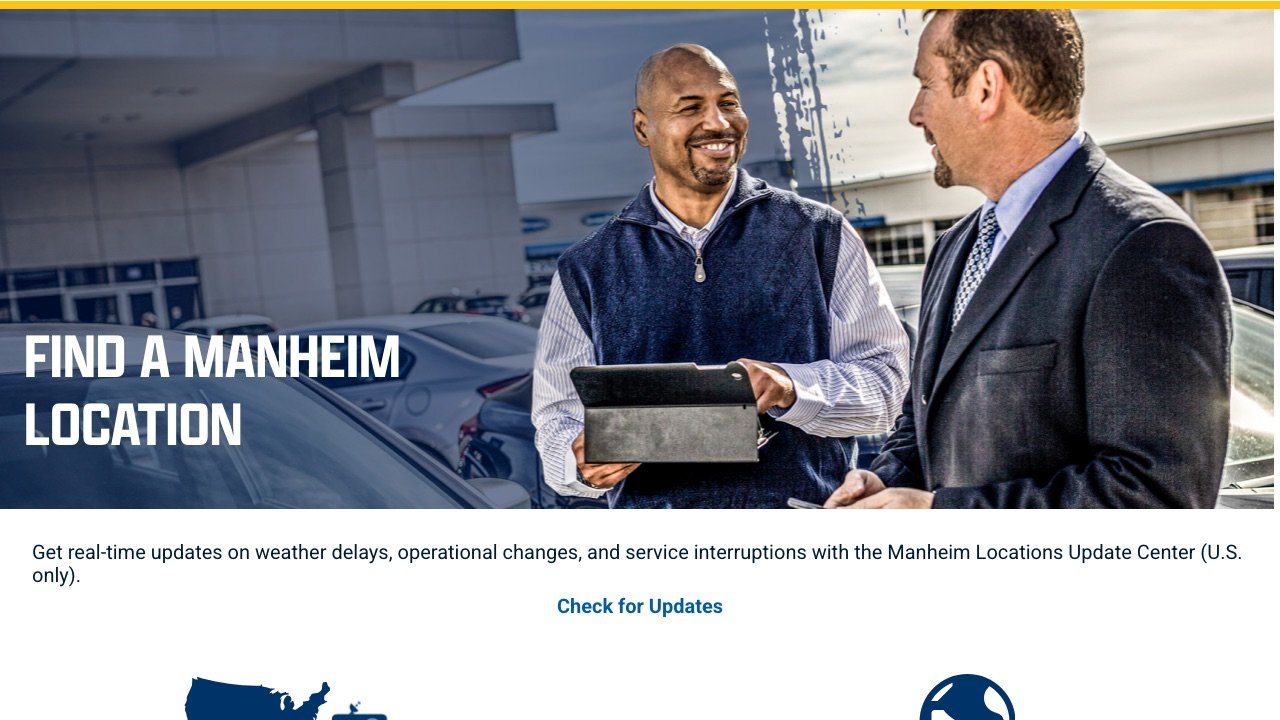
The most like-for-like substitute. Physical lanes plus digital, national coverage, and a consignor base that overlaps with Manheim’s only partially. Since coming under Carvana, the off-lease and fleet pipeline has strengthened. If you are only going to add one account, add this one.
2. ACV Auctions
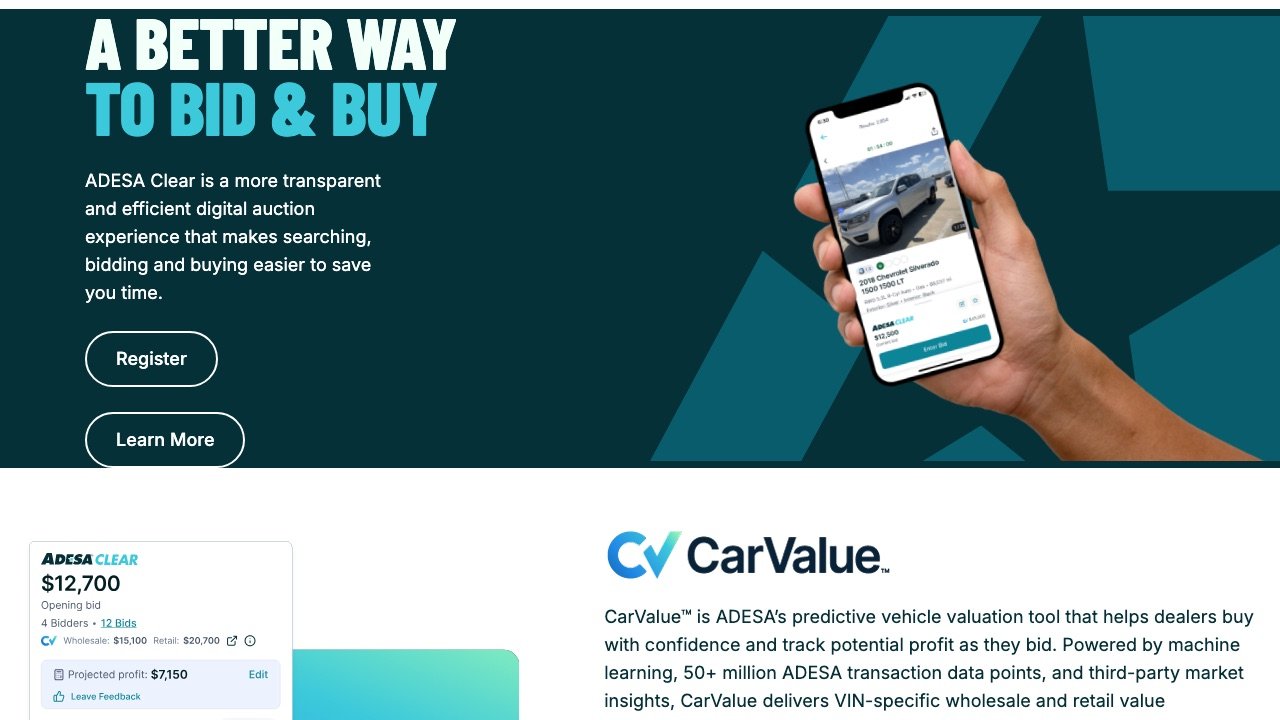
The most genuinely different option on this list. ACV runs short, online-only sales built around a standardised third-party inspection — including engine audio, undercarriage imagery and a written condition grade. That inspection layer is what makes buying sight-unseen work.
Where it wins: dealer trade-ins that would otherwise sit in a lane for a week. Where it does not: if you need to physically walk a unit before committing, ACV is not for you.
3. OPENLANE
Digital wholesale with a strong captive-finance and off-lease pipeline. Clean, late-model, retail-ready inventory with well-documented histories. Lower fee load than a physical lane because there is no lane to run.
4. America’s Auto Auction
An independent regional network. The catalogue is smaller, but so is the bidder pool, and that shows up directly in the numbers. Dealers inside their footprint frequently report better acquisition costs than at the majors on comparable units.
5. XLerate Group
Another independent network with regional strength. Same logic as above: less competition per lot, more room for a relationship with the auction manager to matter.
6. Copart and IAAI
Not a Manheim substitute for retail-ready units, but the right answer if you have reconditioning capacity. Total-loss and salvage inventory at prices that make sense when you can do the work in-house. Requires real skill at remote damage assessment — the downside risk is much steeper than at a standard wholesale lane.
7. Direct dealer-to-dealer networks
The fastest-growing category and the least discussed. Groups of independents, or a single multi-rooftop group, running their own private bidding platform for units before they ever reach a public lane.
The appeal is straightforward. No banded buy fee. No transport to a physical lane and back. No arbitration with a stranger. Just a closed room of dealers you already know, bidding on units with condition reports you trust.
Running the numbers on the private option
Here is the calculation worth doing. Take your annual wholesale fee spend — buy fees, sell fees, transport, arbitration time — and divide it by twelve. If that monthly figure is above roughly $8,000 to $10,000, a private platform starts to look less like a project and more like a cost saving.
What it takes to be credible: standardised condition reporting that buyers actually trust, proper proxy bidding with soft-close anti-sniping, arbitration workflow, mobile-first access, and automated settlement. None of that needs building from scratch — it is all in the standard car auction software stack.
What you do need to invest in is the inspection discipline. Every successful private dealer auction we have worked on has one thing in common: consistent, honest condition reports. Cut corners there and the room stops bidding within two sales.
Further reading: must-have car auction software features and launch an online car auction business. Or talk to our team for a straight answer on whether your volume justifies it.
Frequently asked questions
Is ADESA cheaper than Manheim?
Fee schedules are broadly comparable and both are banded by sale price. The real difference is inventory access, not cost. Compare on which platform has the units you actually retail.
Can I buy wholesale without a dealer licence?
Not at any of the platforms above. Public alternatives exist — government surplus, eBay Motors, public consignment auctions — but they are a different market with different pricing.
What is the biggest risk in moving away from Manheim?
Losing access to MMR as a pricing reference. Most dealers who diversify keep a Manheim account for the data even when they buy elsewhere.
