Dealer-only auctions are a closed economy. You need a licence to get in, the fee schedules are opaque until you are inside, and the platform you choose shapes what inventory you see all year. Picking well matters more than most dealers admit.
Here are the nine that carry real volume in North America, sorted by what they are actually best at — followed by the calculation that leads a growing number of dealer groups to build private auction platforms of their own.
The volume leaders
1. Manheim
Still the default. Physical lanes across dozens of locations plus a substantial digital operation, and the MMR valuation dataset is a genuine reason to stay even if you buy elsewhere. Fee schedules are banded by sale price rather than flat percentage, which means cheap units carry a proportionally heavy load.
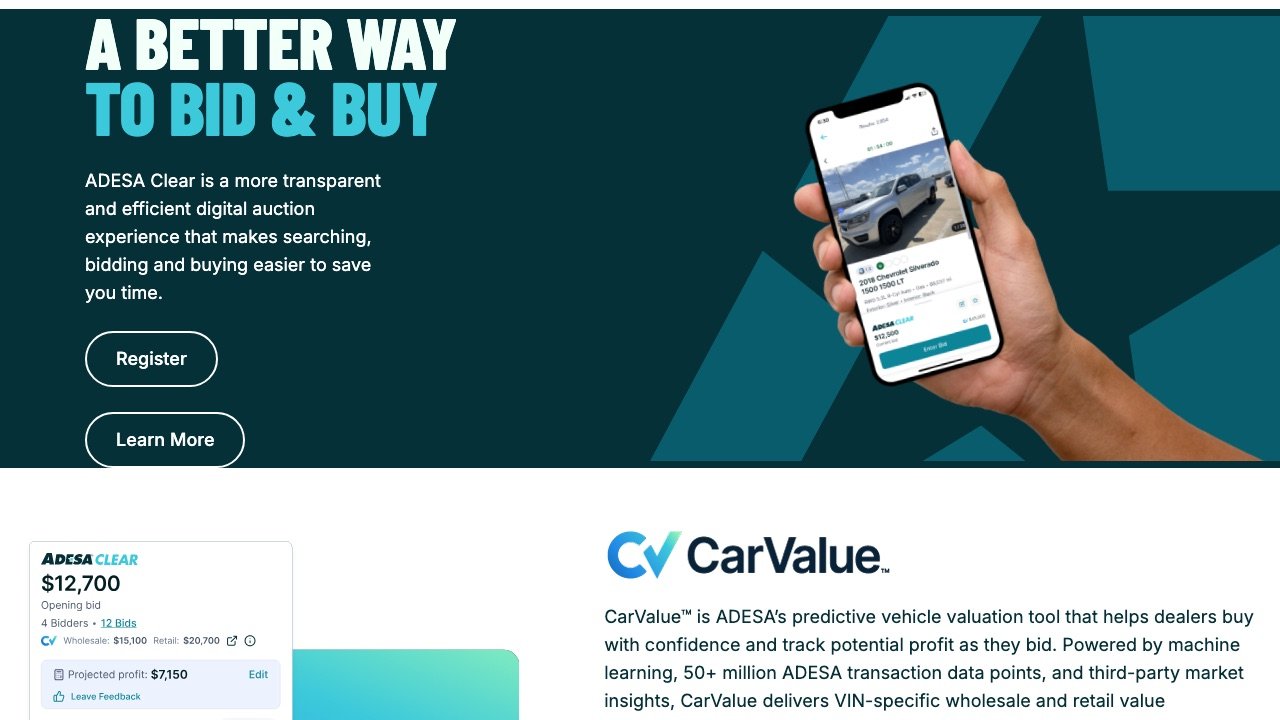
2. ADESA
The main structural competitor, now inside Carvana. Different consignor relationships mean different inventory, particularly in off-lease and rental fleet. Most volume dealers hold accounts at both and treat them as one market.
3. OPENLANE
Digital-first, strong in off-lease and captive finance inventory. Good for dealers who want retail-ready late-model stock without the lane theatre.
Inspection-led platforms
4. ACV Auctions
ACV’s whole proposition is that you can buy confidently sight-unseen because the inspection is standardised and thorough — including an engine audio recording that catches problems a photo set never would. Sales are short and online-only. For dealers buying from other dealers’ trade-ins, it has changed the default.
5. Carvana Dealer / DealerBlock
Condition-report-led digital wholesale with a similar philosophy. Worth an account for the inventory access alone.
Specialist and salvage-adjacent
6. Copart Dealer Services
For dealers with a reconditioning operation or dismantling capacity. Salvage and total-loss inventory at prices no retail channel touches, with the obvious caveat that you need the skills to assess damage remotely.
7. IAAI Dealer
Same category, different insurance carrier relationships. Stronger condition documentation on average.
8. America’s Auto Auction and 9. XLerate Group
Independent regional networks. Smaller catalogues, but noticeably less competition per lot, and relationships with the auction manager still count for something in a way they no longer do at the majors. For dealers in their coverage areas these are often where the margin actually is.
What the fees really cost you
Run the numbers on a full year rather than a single transaction. A dealer moving 40 wholesale units a month at an average all-in auction fee of $400 per unit — buy fee, sell fee, transport arrangement, arbitration overhead — is spending roughly $190,000 a year on access to a marketplace.
That figure is what makes the next section relevant.
When building your own becomes the right answer
A private dealer auction is not a fantasy for large groups any more. The pattern that works looks like this:
- A dealer group or a network of independents pools trade-ins that would otherwise go to a public lane
- Bidding is gated to verified dealers in the network — a closed, trusted room
- The platform charges a modest flat fee instead of a banded percentage, so cheap units stay economic
- Units that do not sell in the private round roll out to the public wholesale channels automatically
The economics work because the marginal cost of running a sale on your own platform is close to zero once it is built. Groups doing 300+ units a month typically recover the build inside a year.
What you need to make it credible: standardised condition reports (buyers will not bid sight-unseen without them), reliable proxy bidding with soft close, arbitration workflow, and mobile access — see mobile auction app, because used car managers do not sit at desks.
Our car auction software covers the module set, physical vs. online car auctions covers why the shift happened, and launch an online car auction business covers the commercial model.
Frequently asked questions
Do I need a dealer licence for all of these?
Yes, for every platform on this list. Licence requirements vary by state and some platforms require additional verification such as a surety bond or physical lot inspection.
Which dealer auction has the lowest fees?
Regional independents generally undercut the majors, and digital-only platforms undercut physical lanes because they carry no lane overhead. Compare on all-in cost per unit rather than headline buy fee.
How many units do I need to justify a private platform?
As a rough rule, groups moving over 150 wholesale units a month should at least run the numbers. Talk to our team and we will model it against your actual fee spend.
